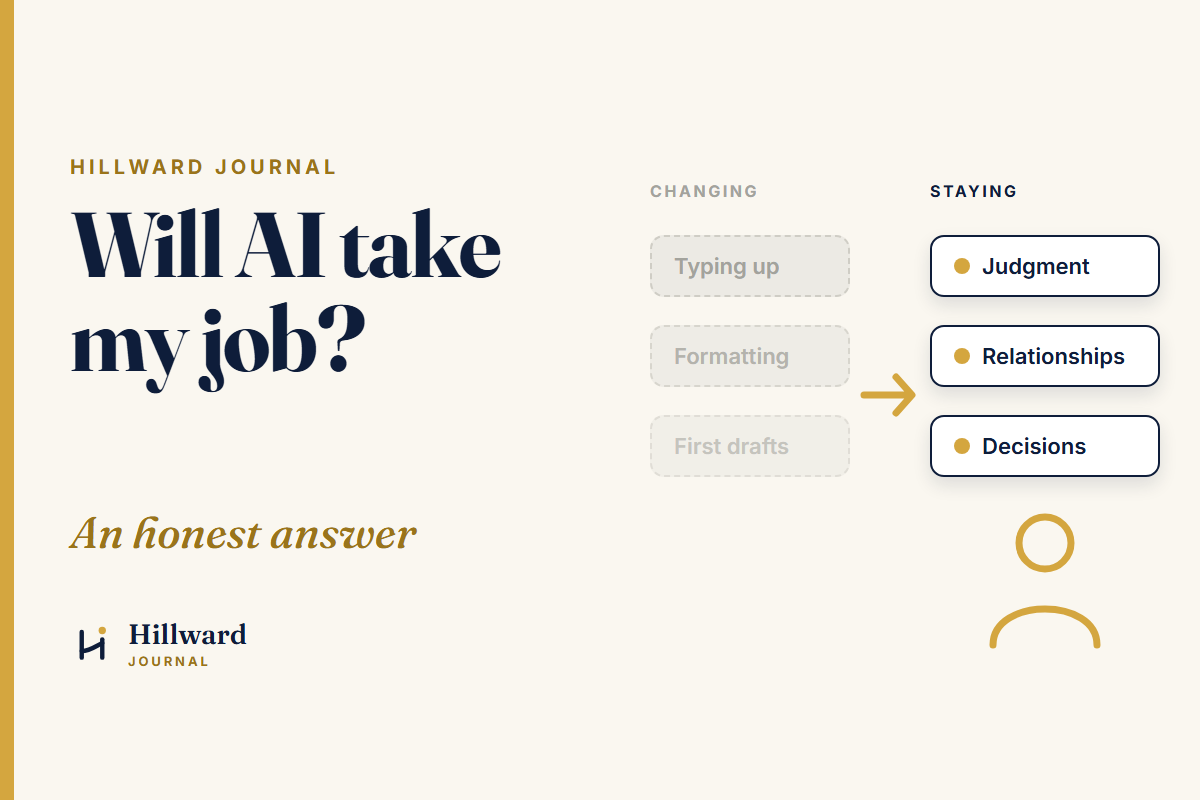
It is one of the most common questions about AI at work, and people often ask it quietly: “Be honest with me. Will AI take my job?”
It is a fair question, and it deserves a straight answer, not hype and not fear. So here is mine, built on what the research actually says.
Figures below are from the latest editions of the reports as of 6 October 2026.
The short answer
For most people, AI is far more likely to change your job than to take it. But the change is real, it has already started, and the people who refuse to adapt are the ones at risk.
Or, as I often say: AI won’t replace you. But it will replace those who refuse to reinvent themselves.
What the research says
Two of the most widely cited studies point in the same direction.
The International Labour Organization (ILO), the UN agency for work, published a global study with Poland’s national research institute in May 2025. It found that about one in four jobs worldwide (25%) is in an occupation potentially exposed to generative AI, the kind of AI that writes, summarises and creates. In high-income countries the figure is higher, 34%.
But here is the part that rarely makes the headlines. The ILO says full automation of jobs “remains limited”, because many tasks, even when done faster, still need a human. Its conclusion is that transformation, not replacement, is the most likely outcome. The authors also stress that these figures measure potential exposure, not actual job losses.
The World Economic Forum’s Future of Jobs Report 2025, based on data from over 1,000 companies across 55 economies, looks ahead to 2030. It expects 170 million new jobs to be created and 92 million to be displaced, a net gain of 78 million. That covers all the big forces at once (technology, the economy, population changes, the green transition), not AI alone.
Two more numbers from that report matter for you:
- Nearly 40% of the skills needed in today’s jobs are expected to change by 2030.
- 77% of employers plan to upskill their workers in response to AI. And, to be fully honest, 41% plan to reduce their workforce where AI automates certain tasks.
Both of those are true at the same time. That is why the answer is not “relax” and not “panic”. It is “prepare”.
Which work is most exposed
The ILO found that clerical jobs face the highest exposure, because generative AI can, in theory, do many of their tasks. The WEF lists cashiers and administrative assistants among the fastest-declining roles.
Notice the pattern. It is not whole professions disappearing overnight. It is repetitive tasks inside many jobs: typing up, formatting, summarising, sorting, first drafts. If a large share of your week is that kind of work, your role is the one most likely to change.
I know this kind of work well. I started my career in banking as a teller and customer service representative, then spent four years freelancing in websites, content, research and design. Since 2023, AI has been at the core of almost everything I do. It did not take my work. It took the slowest parts of it, and gave me time for the parts that need judgment.
What this means in Nigeria
Most of the global data is not Nigeria-specific, so be careful with anyone who quotes a precise “Nigerian jobs lost to AI” figure. But our own government has made its view clear. Nigeria’s National AI Strategy aims to equip at least 70% of the young workforce, aged 16 to 35, with AI-related skills. The national bet is on people who can use AI, not on replacing people with it.
There is also an opportunity many people miss. In a market where many offices still do a lot of work by hand, the professional who learns to use AI well does not just keep up. They stand out.
Three things to do now
1. List your repetitive tasks. Take ten minutes and write down the tasks in your week that are mostly typing, formatting, summarising or rewriting. Those are where AI can help first, and where change will arrive first.
2. Practise on one task a week. Do not try to learn everything. Pick one task, use AI on it for a week, check the results carefully, and keep what works. Small, steady practice beats one big course you never use.
3. Grow the human part of your job. The WEF report says skills like analytical thinking, resilience, leadership and collaboration remain critical. Judgment, relationships and knowing your organisation are the parts AI cannot copy. Spend the time you save there.
The honest bottom line
AI is not coming for you as a person. It is coming for the slow, repetitive parts of work, and that is not entirely bad news. The risk is standing still while those parts disappear around you.
You don’t need to be technical to stay relevant. You need to start, and you need the right guide.
Your next step
Start with our Start here page. It shows you how to write a good prompt, how to build the habit one task a week, and what to keep out of AI tools.
If you lead a team that is anxious about AI, we run practical training that starts with real work, not theory. See our services.
What is the one task in your week you would happily hand to AI tomorrow?
One useful idea, every Thursday.
The Hillward weekly note: a short tip, tool or lesson in plain English. Unsubscribe any time.
We use your email only to send the weekly note. Privacy policy
Sources
- ILO, “One in four jobs at risk of being transformed by GenAI, new ILO–NASK Global Index shows” (20 May 2025): https://www.ilo.org/resource/news/one-four-jobs-risk-being-transformed-genai-new-ilo%E2%80%93nask-global-index-shows
- ILO, Generative AI and jobs: A 2025 update: https://www.ilo.org/publications/generative-ai-and-jobs-2025-update
- World Economic Forum, “Future of Jobs Report 2025: 78 Million New Job Opportunities by 2030” press release (8 January 2025): https://www.weforum.org/press/2025/01/future-of-jobs-report-2025-78-million-new-job-opportunities-by-2030-but-urgent-upskilling-needed-to-prepare-workforces/
- NCAIR/NITDA, National Artificial Intelligence Strategy (September 2025): https://ncair.nitda.gov.ng/wp-content/uploads/2025/09/National-Artificial-Intelligence-Strategy-19092025.pdf