You may have heard that Nigeria now has a national AI strategy. Chances are you have not read it. That is understandable: the full document runs to 81 pages, and it was written for policymakers, not for someone with a report due on Friday.
So here is the short version: what it says, what has happened around it, and what it means for your work, in plain English.
Facts below are as of 6 October 2026. Policy moves fast, so check the sources at the end for anything newer.
What the strategy is
The National Artificial Intelligence Strategy is led by the Federal Ministry of Communications, Innovation and Digital Economy, with NITDA (the National Information Technology Development Agency) as a key implementing body. According to the OECD’s AI policy tracker, it was published in September 2025 and sets a five-year vision, 2025 to 2029.
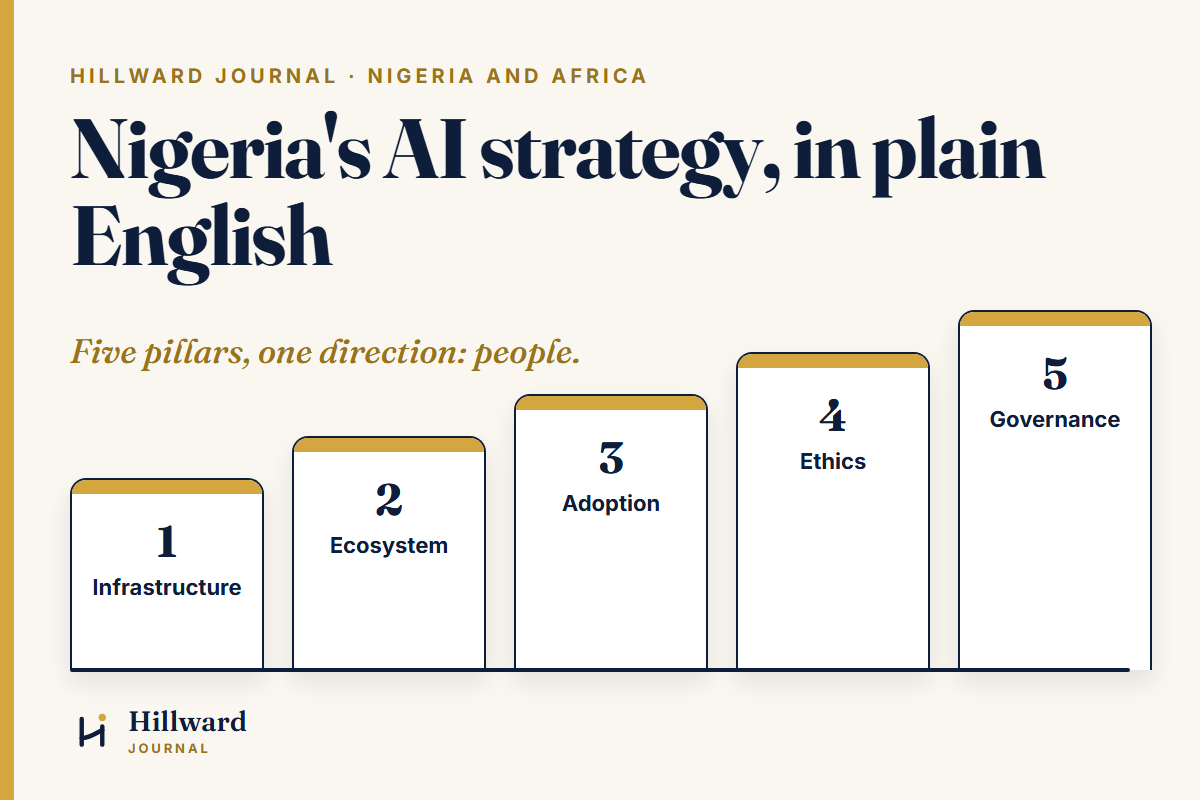
It rests on five pillars:
- Building foundational AI infrastructure (computing power and the energy to run it)
- Building and sustaining a world-class AI ecosystem (talent, partnerships, innovation hubs)
- Accelerating AI adoption and sector transformation (agriculture, health, education, finance, public services)
- Ensuring responsible and ethical AI development and deployment
- Developing a robust AI governance framework (the rules and the bodies that enforce them)
The part that matters most for you: skills
Here is the line I would underline. The strategy aims to reduce unemployment by five percentage points by equipping at least 70% of Nigeria’s young workforce, aged 16 to 35, including 50% women, with AI-related skills and knowledge.
Whatever you think of the target, notice what it says about direction. The government is not only betting on machines. It is betting on people who know how to use them. When the national plan puts skills at the centre, employers will follow, and “comfortable with AI tools” will increasingly sit next to “proficient in Microsoft Office” on job descriptions.
The strategy is also honest about the obstacles. It names unreliable infrastructure, low broadband reach, a shortage of skilled AI professionals, brain drain, and research spending of about 0.2% of GDP against a global average of 2.2% (citing the World Bank). I found that candour encouraging. A plan that admits the hard parts is easier to trust.
Something you can already see: N-ATLAS
In September 2025, the Federal Government unveiled N-ATLAS, described by NCAIR (the National Centre for Artificial Intelligence and Robotics) as Nigeria’s first open-source, multilingual large language model. A “large language model” is the kind of AI behind tools like ChatGPT: software trained on huge amounts of text to understand and write language.
N-ATLAS supports Yoruba, Hausa, Igbo and Nigerian-accented English, and includes speech recognition, so it can work with voice as well as text. It is built on Meta’s Llama 3 model and released openly, which means developers can download it and build on it.
You are unlikely to use N-ATLAS directly at your desk this week. It is mainly a foundation for developers. But it matters for one reason: AI that understands our languages and our accents opens the door to services for millions of Nigerians who do not work in English or do not type. If you work in an NGO, a church, a school, health or agriculture, that is worth watching.
What about AI laws?
This is where many people get confused, so let me be precise.
Nigeria does not have one settled AI rulebook yet. According to the IAPP (an international association of privacy professionals), several AI bills have been introduced in the National Assembly since 2021, some were consolidated in December 2024, and a National AI Commission bill was introduced in 2025. As of the IAPP’s analysis in April 2026, Nigeria was still moving toward comprehensive AI regulation. I could not confirm the current stage of these bills, so treat any headline that says “Nigeria’s AI law” with care until you see the final text.
But one set of rules already applies whenever you use AI with personal information: the Nigeria Data Protection Act 2023 and its implementation directive, the GAID, which took effect on 19 September 2025. If you paste a customer’s details, a staff file or a member’s records into an AI tool, data protection law is already in the room, AI law or not.
That is why our Start here page includes a short guide on what never goes into an AI tool. It is the simplest protection you have.
What this means for you: three takeaways
1. Skills are the national priority, so start now. You do not need to wait for a government programme. The most valuable AI skill for most professionals is not technical. It is knowing how to ask clearly, check carefully and use AI on your real work.
2. The data rules are already here. Don’t wait for an AI law to be careful. Treat personal and confidential information with the same care you would on paper, or more.
3. Watch the governance space, calmly. New rules will come. When they do, the people and organisations already using AI responsibly will adjust easily. The ones who ignored it, or used it carelessly, will scramble.
The national plan is ambitious, and plans are not results. But the direction is clear. AI won’t replace you. It will replace those who refuse to reinvent themselves, and in Nigeria, the reinvention now has official backing.
Your next step
If you are just getting started, our Start here page walks you through three steps: writing a good prompt, building the habit one task a week, and keeping sensitive information out.
If you lead a team or an organisation and want help using AI responsibly, see our services.
Which part of the strategy do you think will touch your sector first?
One useful idea, every Thursday.
The Hillward weekly note: a short tip, tool or lesson in plain English. Unsubscribe any time.
We use your email only to send the weekly note. Privacy policy
Sources
- NCAIR/NITDA, National Artificial Intelligence Strategy (PDF, September 2025): https://ncair.nitda.gov.ng/wp-content/uploads/2025/09/National-Artificial-Intelligence-Strategy-19092025.pdf
- OECD.AI Policy Navigator, “National Artificial Intelligence Strategy (NAIS)”, Nigeria (updated 28 April 2026): https://oecd.ai/en/dashboards/policy-initiatives/national-artificial-intelligence-strategy-nais
- NCAIR, National AI Innovation Challenge page, description of N-ATLAS (checked 6 October 2026): https://ncair.nitda.gov.ng/naic/
- N-ATLaS model card on Hugging Face (checked 6 October 2026): https://huggingface.co/NCAIR1/N-ATLaS
- IAPP, “Nigeria moves toward comprehensive AI regulation”, Victoria Adaramola (8 April 2026): https://iapp.org/news/a/nigeria-moves-toward-comprehensive-ai-regulation
- Nigeria Data Protection Commission, NDP Act General Application and Implementation Directive (GAID) 2025: https://ndpc.gov.ng/wp-content/uploads/2025/07/NDP-ACT-GAID-2025-MARCH-20TH.pdf (effective date 19 September 2025 confirmed by law-firm notes from Banwo & Ighodalo and Balogun Harold)